A US-Russian astronaut crew has safely returned to Earth after spending eight months aboard the International Space Station, completing a mission focused on scientific research and international space cooperation.
Astronaut Crew Returns Safely After Extended ISS Mission
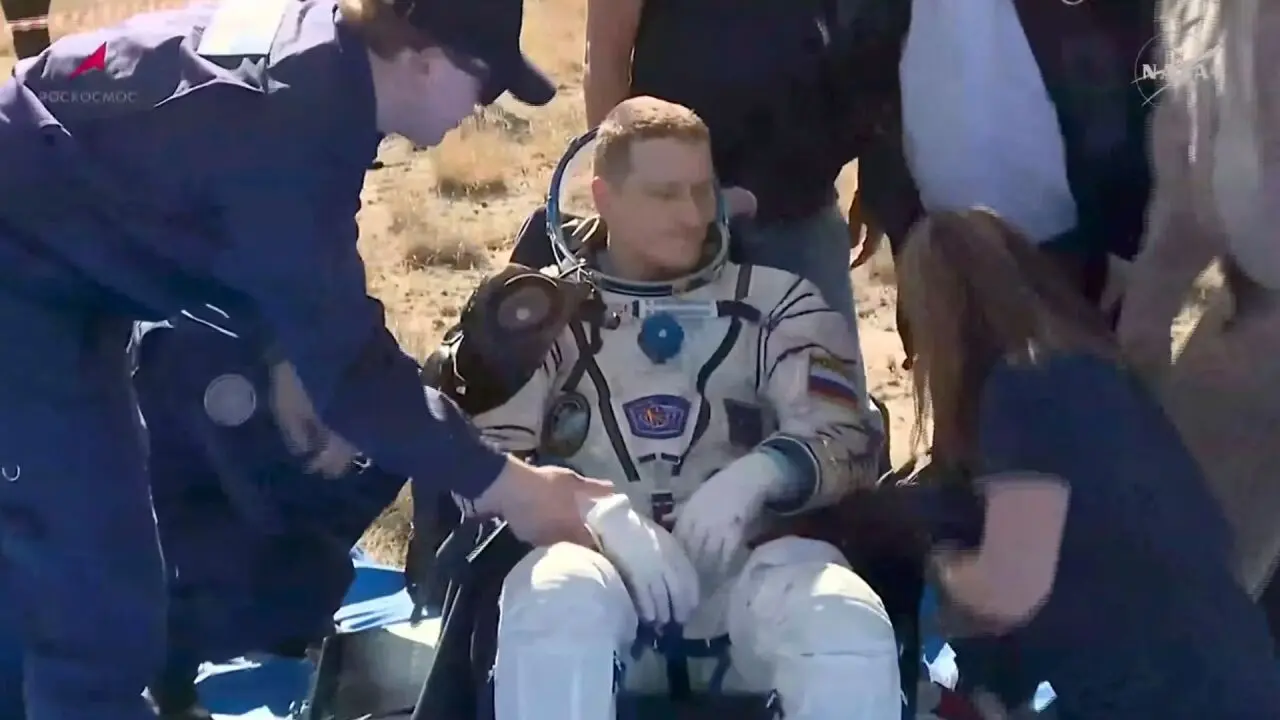
A US-Russian space crew has successfully returned to Earth after completing an eight-month mission aboard the International Space Station, landing safely in Kazakhstan following an extended period of scientific research and orbital operations. The successful return marked the conclusion of a mission that demonstrated continued cooperation between astronauts from different countries despite broader geopolitical tensions on Earth. The spacecraft carrying the crew touched down in Kazakhstan, where recovery teams were prepared to assist the astronauts after their long stay in orbit. Medical specialists evaluated the crew members following landing because extended exposure to microgravity can affect balance, muscle strength, and overall physical condition. The mission involved astronauts working together on a wide range of scientific experiments designed to improve understanding of human health, space technology, and conditions required for future exploration missions. Research conducted aboard the ISS contributes to preparations for longer missions to the Moon, Mars, and other destinations beyond low-Earth orbit. During their eight months aboard the station, the crew supported daily ISS operations, maintained critical systems, conducted experiments, and assisted with scientific investigations involving biology, materials science, and Earth observation. The return highlights the continuing role of the International Space Station as a symbol of scientific collaboration. Despite political disagreements between the United States and Russia in recent years, space cooperation has remained one of the areas where both countries continue working together. NASA and Russia’s space agency have maintained operational partnerships aboard the ISS, allowing astronauts from both nations to participate in joint missions. Officials from both sides have repeatedly emphasized the importance of maintaining safety and cooperation in space operations. The successful landing demonstrates the reliability of international spaceflight procedures and the ability of multinational crews to complete complex missions together. As the astronauts begin their recovery process, scientists will continue analyzing data collected during the mission. The findings are expected to contribute to future space exploration efforts and improve understanding of how humans adapt to extended periods in space.
International Cooperation Continues Despite Earthly Tensions
The mission represents another example of how space exploration has remained a field of cooperation between countries that often experience political disagreements on Earth. The International Space Station has operated for decades as a shared scientific platform involving the United States, Russia, Europe, Japan, and other international partners. The partnership between NASA and Russia’s space program has been particularly significant because both nations played major roles in developing and maintaining the ISS. Their cooperation has included astronaut exchanges, spacecraft operations, and shared scientific research. The continuation of joint missions has demonstrated that space exploration often requires collaboration because of the enormous technical, financial, and scientific challenges involved. Building and operating a space station requires expertise from multiple countries working together. However, maintaining cooperation has not always been easy. Political tensions, sanctions, and disagreements between governments have created uncertainty about the future of some international space partnerships. Despite these challenges, space agencies have generally prioritized mission safety and operational continuity. Astronauts aboard the ISS depend on one another regardless of nationality because successful missions require teamwork and trust. Space experts say the ability to maintain cooperation in orbit provides valuable lessons for future international missions. Large-scale exploration projects, including potential missions to Mars, will likely require collaboration between multiple countries due to their complexity and cost. The ISS has also served as a testing ground for international partnerships beyond Earth. Scientists have used the station to study how different teams work together in isolated environments where communication, coordination, and reliability are essential. The successful return of the US-Russian crew reinforces the idea that scientific collaboration can continue even during periods of political uncertainty. As countries prepare for the next generation of space exploration, the experience gained from ISS partnerships will influence future missions involving governments, private companies, and international organizations.
Scientific Research Conducted During Eight Months in Orbit
During their eight-month stay aboard the International Space Station, the crew participated in numerous experiments designed to improve scientific knowledge and support future human space exploration. Research conducted in microgravity provides insights that cannot easily be achieved on Earth. One major area of study involves understanding how the human body changes during long periods in space. Astronauts experience muscle loss, bone density changes, and shifts in cardiovascular function while living in microgravity. These studies help scientists develop methods to protect astronauts during longer missions. The crew also contributed to research involving materials science, where scientists examine how different substances behave without the effects of Earth’s gravity. These experiments can lead to improvements in manufacturing processes, medicine, and technology. Earth observation research was another important part of ISS activities. Astronauts capture images and collect data that help scientists study weather patterns, climate changes, natural disasters, and environmental conditions around the planet. Space station experiments also support the development of technologies needed for future exploration. Systems designed for life support, recycling, communication, and spacecraft operations are tested in orbit before being used on deeper space missions. The knowledge gained from ISS research plays a crucial role in preparing for future missions to the Moon and Mars. Longer journeys will require advanced solutions for protecting astronauts and maintaining reliable equipment. Scientists say every mission contributes to a larger understanding of how humans can safely live and work beyond Earth. The ISS provides a unique environment where researchers can test ideas before applying them to future exploration programs. The returning astronauts will continue participating in medical evaluations and scientific studies after landing. Their experiences provide valuable information about the effects of extended spaceflight. The research completed during the mission represents another step toward expanding human presence beyond low-Earth orbit.
Crew Begins Recovery After Returning From Microgravity Environment
After spending eight months in space, the returning astronauts will undergo a carefully managed recovery process to help their bodies adjust to Earth’s gravity. Long-duration space missions create physical challenges because the human body adapts to weightlessness during extended periods in orbit. Immediately after landing, astronauts often experience difficulty standing and walking because their muscles and balance systems must readjust. Recovery teams provide medical support and monitor important health indicators during the first hours and days after returning. Physical rehabilitation is an important part of the post-flight process. Astronauts participate in exercises designed to rebuild strength, improve coordination, and restore normal movement patterns. Scientists study returning astronauts because their experiences provide important information about human adaptation to space. Understanding recovery after long missions is essential for future exploration beyond Earth’s orbit. A mission to Mars, for example, would involve months or years away from Earth and would require astronauts to remain healthy in a challenging environment. Research from ISS missions helps engineers and medical experts develop better protection strategies. The psychological aspects of long-duration missions are also studied. Living in a confined spacecraft environment requires teamwork, communication, and emotional resilience. The returning crew members will share their experiences with scientists, engineers, and future astronauts. Their observations can help improve mission planning and spacecraft design. Space agencies consider every astronaut mission an opportunity to learn more about human spaceflight. The information collected after landing is just as important as the research completed while in orbit. The safe return of the US-Russian crew demonstrates the progress made in managing long-duration missions and preparing astronauts for increasingly ambitious journeys.
Future Space Missions Build on ISS Experience
The successful completion of the eight-month ISS mission contributes to preparations for the next era of human space exploration. Space agencies around the world are using lessons learned from the station to develop future missions beyond low-Earth orbit. NASA and international partners are working toward expanded lunar exploration through programs designed to establish a sustainable human presence near the Moon. The technologies and operational experience gained from the ISS will support these efforts. Future missions will require advanced life-support systems, improved spacecraft, reliable communication networks, and strategies for protecting astronauts from radiation and isolation. Private space companies are also becoming increasingly involved in human spaceflight. Commercial spacecraft, space stations, and exploration technologies are expected to play a larger role in the future of the industry. The ISS has provided decades of experience in managing international crews and complex orbital operations. This knowledge will be valuable as humanity prepares for more ambitious missions. Experts believe cooperation will remain important because large-scale space exploration requires significant resources and expertise. International partnerships could help accelerate scientific progress and reduce costs. The return of the US-Russian crew serves as a reminder that space exploration continues advancing despite challenges on Earth. Scientific goals and operational needs often create opportunities for collaboration. As the world looks toward future missions, the achievements of ISS astronauts will continue influencing how humans explore space. The successful landing in Kazakhstan marks the end of one mission but represents another step toward humanity’s broader goal of living and working beyond Earth.